
Wine Bottle Size Guide
We are all familiar with the traditional 750 ml wine bottle and its iconic shape with straight sides and square shoulders. But did you know that there are dozens of different sizes? Balthazar, Salmanazar, Piccolo: they all have their own unique name. In this quick guide, our wine experts present everything you need to know about wine bottles, their sizes, and their names.
The summary in 30 seconds
- What is the standard size?
- 750 ml, or about 6 glasses of wine.
- Why 750 ml?
- This format, established in 1866, simplified trade between France and England: a 225-liter barrel is equivalent to 300 bottles.
- The smallest?
- The Piccolo, with 200 ml, or about 1.5 glasses.
- The largest?
- The Melchizedek, with 30 liters, or 240 glasses.
- Does the format change the wine?
- Yes: the larger the bottle, the better the wine ages and the less it risks oxidation.
Why are wine bottles 750 ml?
The standard size for a wine bottle is 750 ml. This format was officially established in 1866 to facilitate trade between the French and the English, who were the main customers of French wine estates at the time.
Back then, measuring systems (liters for the French, gallons for the English) were a source of disagreement during trade. Indeed, the imperial gallon is exactly equivalent to 4.54609 liters, which made conversions from one measure to the other laborious.
To avoid these complications, both peoples agreed to transport 225 liters of wine in a barrel, which is equivalent, when rounded, to 50 gallons. The goal: to have a round number.
Key statistic
A 225-liter barrel corresponds exactly to 300 bottles of 750 ml, or about 50 imperial gallons.
Setting the capacity of a bottle at 750 ml therefore solved the conversion problem and facilitated trade.
750 ml bottles were subsequently standardized on a European and then global scale. A gallon thus corresponds to 6 bottles: this is the reason why cases of wine are mostly sold in 6s or 12s.
What are the names of wine bottles according to their size?
Wine bottles come in a variety of shapes and sizes, each with a unique name. Their capacity was not chosen at random: it actually corresponds to a certain type of consumption.
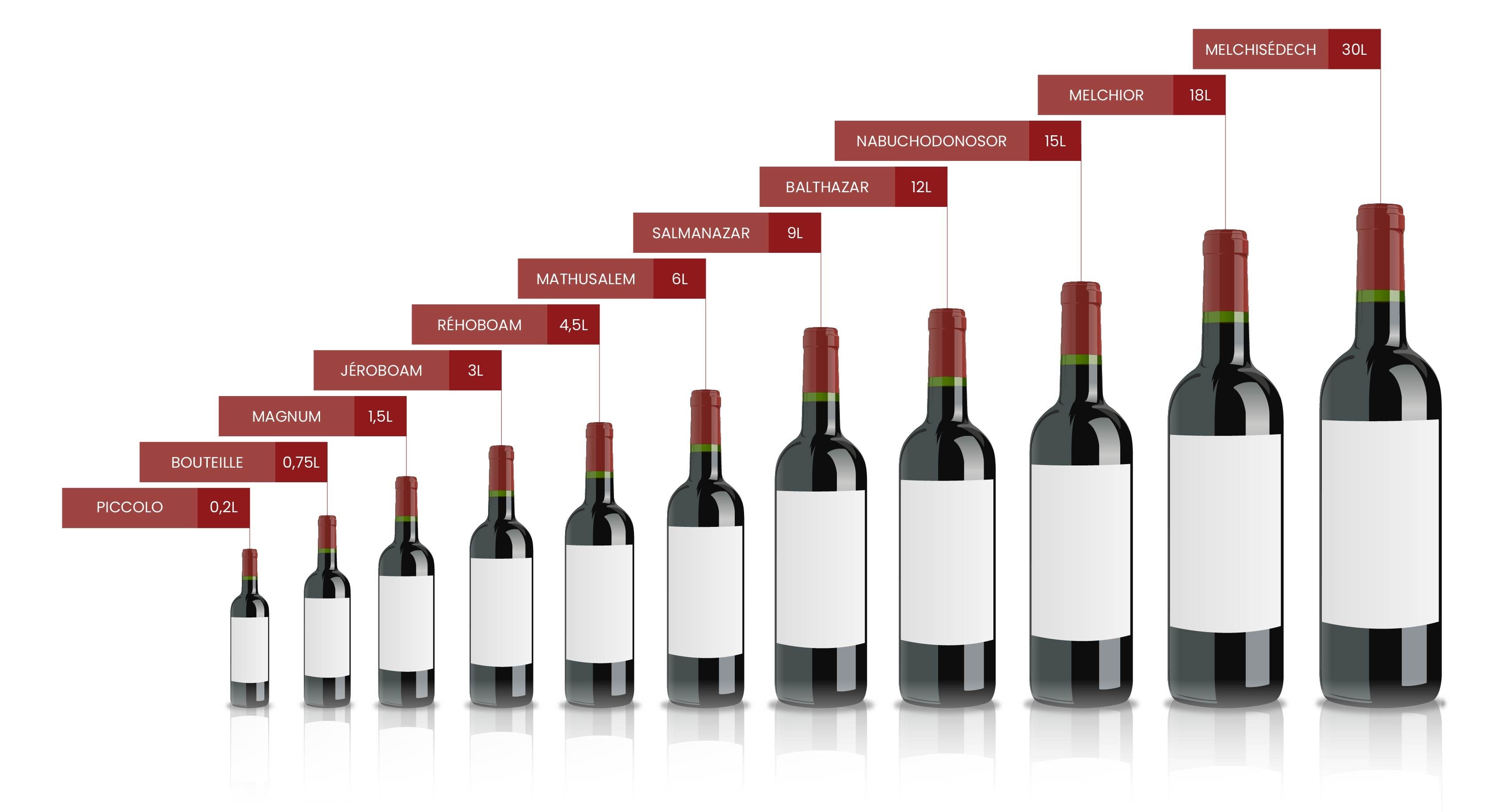
The smallest size is the Piccolo, which contains only 200 ml of wine, or 1.5 glasses. Next comes the half-bottle, at 375 ml, followed by the standard bottle, at 750 ml. Then we find the Magnum (1.5 liters) and the Jeroboam (3 liters).
Large formats begin with the Rehoboam (4.5 liters), the Methuselah (6 liters), and the Salmanazar (9 liters). Finally, there are the last three: the Balthazar (12 liters), the Nebuchadnezzar (15 liters), and the Melchior (18 liters). Much less known, the Melchizedek reaches a capacity of 30 liters.
Pro tip
Are you a fan of fine bottles and wish to invest in a wine cellar? Check out our guide to buying a wine cellar, which will truly meet your needs.
Summary of bottle sizes and names according to their capacity
| Bottle name | Capacity | Number of glasses |
|---|---|---|
| Piccolo | 0.2 L | 1.5 glasses |
| Half-bottle | 0.375 L | 3 glasses |
| Bottle | 0.75 L | 6 glasses |
| Magnum | 1.5 L | 12 glasses |
| Jeroboam | 3 L | 24 glasses |
| Rehoboam | 4.5 L | 36 glasses |
| Methuselah | 6 L | 48 glasses |
| Salmanazar | 9 L | 72 glasses |
| Balthazar | 12 L | 96 glasses |
| Nebuchadnezzar | 15 L | 120 glasses |
| Melchior | 18 L | 144 glasses |
| Melchizedek | 30 L | 240 glasses |
How important is the format of a wine bottle?
The size of a bottle is not just a question of aesthetics or price. The format also plays an essential role in the optimal storage of wine. Indeed, the larger the container, the better the wine keeps.
To properly store a wine, it is necessary to avoid any sudden changes in temperature, which risks altering its quality and hindering its aging. However, the larger a bottle is, the longer it takes for the liquid inside to change temperature.
Wine contained in a large bottle also presents less risk of oxidation than in a small one. Exchanges with ambient air through the cork indeed have less impact as the quantity of wine increases.
Pro tip
For a wine meant for long-term cellaring, favor the Magnum: its greater mass of wine protects it better from temperature fluctuations and oxidation.
Vinum Design, your reference for wine and spirits accessories
There are a dozen different wine bottle sizes, each with a unique name. The format you choose will depend on several factors, including the occasion, the aging time, and your personal preferences.
At Vinum Design, we offer a wide selection of wine accessories so that all enthusiasts can fully live their passion: wine glasses, wine racks, wine decanters, and more, on our online store or in one of our shops.
Give your bottles the display they deserve
From Piccolo to Magnum, discover our accessories and wine cellars designed to serve and store every format in the best conditions.
Share